The Third Quarter of 2025 for the Estonian Startup Sector: Productivity Gains, Tax Resilience, and Deeptech Momentum
Below is the abridged version of the full report. For more detailed information, refer to the full version available here.
Executive summary
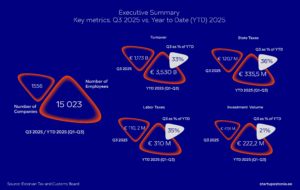
In Q3 2025, the Estonian startup sector set its vector on productivity and a continuing search for efficiency. The sector’s turnover increased by 15% to €1.173 billion, representing about 33% of the year-to-date total of €3.530 billion. This surge far outpaced the broader private sector, with the startup turnover growing more than seven times faster than the modest 2% rise seen across all enterprises combined.
Employment remained steady, rising just 1% to 15,023. Meanwhile, state and labor taxes surged by 18% and 13% respectively to €120.7 million and €110.2 million, which brought year-to-date figures to €335.5 million and €310 million, with Q3 making up roughly 36% of both totals—a clear reflection of enhanced profitability and growing wages.
Investments presented a mixed outlook, with volume declining 27% to €47.4 million against a year-to-date total of €222.2 million. However, deal count rose 27%, local participation reached 60%, and notable international exits in fintech and cybersecurity once again affirmed the sector’s global appeal.
In DeepTech, state taxes increased by 49% to €18.2 million, well above the 5% growth seen in turnover and employment. This indicates broad productivity improvements and higher wages, although the muted revenue growth suggests a need for a deeper examination of the revenue structure in order to locate the sources of this skyrocketing efficiency
Overall, these trends affirm the sector’s sustained stability, powered by agility and innovation as it moves forward
Introduction
The Q3 2025 report on the Estonian Startup Sector focuses on the performance of companies included in the sample curated by Startup Estonia (SUE). The latest sample is available on SUE’s Tableau Public dashboard and in the Dealroom database under the tag “Startup Estonia.” Our mission is to provide a bird’s-eye view of key economic metrics and deliver insights into the current state of Estonian startup and scaleup companies. This report highlights interim trends based on analyses of turnover, employment, taxes, investments, and other key indicators. The efficiency trend observed in the previous H1 2025 report continues to resonate across the entire startup ecosystem, with particularly pronounced effects in the Deeptech segment.
Sample and methodology
The performance of economically active companies in Estonia’s startup sector is tracked using data from the Estonian Tax and Customs Board (EMTA).
For Q3 2025, the total sample from the Tableau data platform includes 1,556 startups, of which 1,324 were economically active during this period, representing approximately 85% of the total. Additionally, the sample incorporates 16 companies that ceased operations between April and September but showed signs of economic activity before shutting down, increasing the sample to 1,340. The remaining 15% of the Tableau sample either show no economic activity or are in distress (e.g., liquidation or bankruptcy).
Slight variations may occur in data retrieved from primary resources — Dealroom, EMTA, and crowdsourced investment databases — due to ongoing refinements by Startup Estonia (SUE) or revisions within the sources themselves. As old companies close and new ones emerge, some of the existing startups gain economic prominence, leading to the SUE Dealroom/Tableau sample being adjusted. Despite these updates, the core group of startups and scaleups remains consistent, ensuring comparability. EMTA data, while highly accurate, occasionally shows irregularities due to companies revising submitted turnover or employee counts. Crowdsourced investment data is included only if verified through media reports, meaning unreported investments are excluded from our review.
Employment and taxes
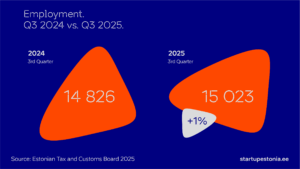
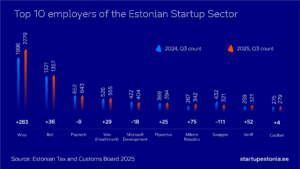
During Q3 2025, the number of employees in comparison with Q3 2024 has largely remained the same, demonstrating a small 1% growth (from 14,826 to 15,023) and the overall job security of the sector. The top 10 employers show varied hiring trends from Q3 2024 to Q3 2025, with modest net growth driven by gains in seven firms offset by declines in three. Standouts like Veriff and Milrem Robotics expanded their employee base by 20% and 28%, respectively, with Wise close behind at +14% but leading in absolute numbers (+283). Bolt and Pipedrive sustained steady growth, expanding the workforce by 3% and 7%, while Yolo (Heathmont) and Coolbet indicated modest gains of 6% and 1%. Conversely, Microsoft Development Center and Playtech slightly contracted, losing 4% and 1% of their employees, with Swappie suffering the biggest cuts (-26% of the total number of employees). Also, even though the layoff of 280 employees by Yolo was announced in the media at the end of Q3 2025, it has yet to be manifested in the official statistics. Overall, the changing economic reality forces even the companies from the top 10 to seek a new balance between expansion and agility. Nonetheless, leaders in the spheres of information and communication, the financial sector, and the manufacturing industry show growth despite the challenges.
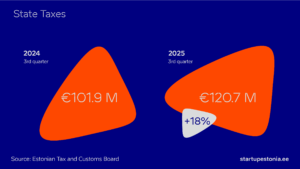
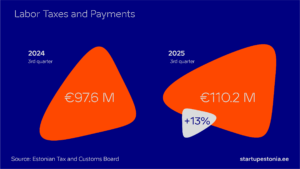
The Estonian startup sector’s state and labor taxes in Q3 2025 demonstrate solid fiscal contributions, with state taxes rising 18% from €101.9 million in Q3 2024 to €120.7 million, and labor taxes increasing 13% from €97.6 million to €110.2 million. This growth in tax revenues, despite the modest overall employment expansion noted earlier, indicates enhanced profitability and increasing wage levels across the ecosystem.
Turnover
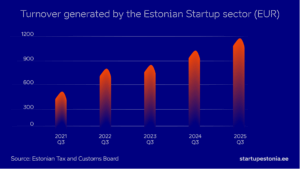
Comparing the Estonian startup sector’s Q3 turnover from 2021 to 2025 reveals a pattern of explosive initial growth followed by a notable slowdown. In 2021, Q3 turnover stood at €518 million, surging 54% to €799.3 million in 2022, driven by a post-pandemic boom. Growth moderated to 19% in 2023, reaching €950.2 million, and further slowed to 8% in 2024, totaling €1.023 billion, signaling accumulated economic challenges. In Q3 2025, turnover rose 15% to €1.173 billion, indicating partial recovery but still falling short of earlier peaks. This dynamic reflects an earlier observed trend of a maturing sector with fewer new companies, growing but at a notably slower pace than four years ago. Still, the 15% turnover growth of the Estonian startup sector remains considerably larger than that of all taxable companies registered by EMTA. According to the most recent data: the Q3 turnover of all aforementioned companies for 2024 was €28.3 billion and became €28.8 billion in 2025, demonstrating an almost 2% growth.
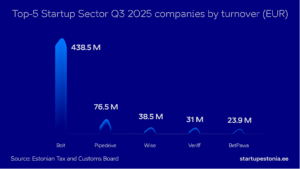
In Q3 2025, the top five Estonian startup sector companies by turnover are traditional leaders: Bolt at €438.5 million, Pipedrive (€76.5 million), Wise (€38.5 million), Veriff (€31 million), and BetPawa (€23.9 million), illustrating a revenue profile dominated by mobility and fintech. The turnover of the top five earners constitutes about 52% of the sector’s €1.173 billion total for the quarter, with Bolt alone accounting for over 37% of the entire sector’s turnover. The continuing domination of Estonia’s high-value digital services demonstrates the overall financial stability of the startup sector, where the underlying shifts will become more visible by the end of the year.
Investments and Exits
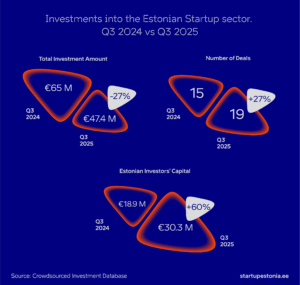
Investments into the Estonian startup sector demonstrate a mixed picture within the general downward trend: the total investment amount fell 27% from €65 million to €47.4 million in overall funding volume. However, the number of deals increased 27% from 15 to 19, indicating more activity despite lower capital deployment. Also, the Estonian investors’ capital share surged 60% from €18.9 million to €30.3 million, which suggests heightened local participation that could offset some of the broader decline demonstrated in the previous report for H1 2025. Nonetheless, despite the positive performance, growing turnover, tax volume, and agility, the Estonian startup sector still has to adapt to the shrinking investment flow, and at the current moment it is hard to predict when this trend will change.
In contrast to the investment trends, during Q3 2025, the Estonian startup sector saw several notable exits that clearly demonstrate its appeal to international buyers, particularly in fintech and cybersecurity. Striga, a fintech platform, was acquired by U.S.-based Lightspark in October, marking a strategic expansion for the acquirer into embedded finance tools. Earlier in September, cybersecurity training firm RangeForce was bought by Israel’s Cyberbit for €15 million, following investments from firms like Energy Impact Partners, Paladin Capital Group, and others. Also in September, crypto media outlet AMBCrypto (Hardfork Media OÜ) was sold to a Dubai-based group in a seven-figure deal, highlighting growing interest in Estonia’s digital media assets. These tech acquisitions by global players, even though focused on a particular niche, reveal a sustained foreign interest in scalable tech innovations produced by the Estonian startup sector.
DeepTech
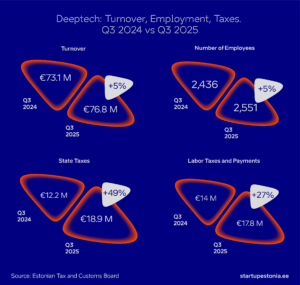
The most interesting observation concerning the Estonian DeepTech sector for Q3 2025 was the 49% surge in state taxes, rising from €12.2 million in Q3 2024 to €18.2 million in Q3 2025, far outpacing the modest 5% turnover growth from €73.1 million to €76.8 million. The same tendency, though in a somewhat smaller proportion, can be observed between the employment, which rose approximately 5% from 2,436 to 2,551, and the increase in labor taxes, which grew 27% from €14 million to €17.8 million.
The highly interesting tendency about this massive tax contribution rise is that it is distributed rather evenly across the whole Estonian DeepTech sector, rather than being focused exclusively at the top. On the one hand, we may observe significant input from the top performers, such as Milrem Robotics, whose contributions jumped 146% from €1.25 million to €3.07 million, and Starship Technologies, up 68% from €1.06 million to €1.77 million, alongside tax outputs from new entrants like KrattWorks OÜ (€1.21 million) and Defsecintel Solutions (€0.82 million), adding over €2.3 million combined. Declines in some firms, like GuardTime (down 41% to €0.28 million), did not change the overall picture, pointing toward either improved profitability or operational efficiencies in key players allowing the tax surge.
On the other hand, looking at the broader picture, the top 20 companies’ share of total state taxes remained stable at around 72-74%, rising from €8.76 million (72% of sector total) in Q3 2024 to €13.5 million (74%) in Q3 2025, supporting the previous statement that the growth was evenly distributed across the sector rather than concentrated solely among leaders. Estonia’s income tax rate increase from 20% to 22%, effective January 1, 2025, partially accounts for this surge, but the increase is too high for it to be the sole reason. A possible explanation might be in the deferrals within the Estonian corporate tax payments, as the income tax applies only to distributed profits (dividends), not directly to turnover or undistributed earnings. So, the companies might have simply cashed in the accumulated profit for several years, causing the spike. Additionally, the high change in labor taxes (+27%) in Q3 2025 reflects genuinely higher wages and a corresponding economic success. Therefore, these factors, combined with the even spread of the change in the state taxes, suggest the entire DeepTech sector’s enhancements in productivity, not just policy-driven effects. The only concern is caused by muted turnover growth, which implies the sector’s tax contributions are increasingly decoupled from revenue expansion.
Authors: Ivan Polynin, Kristi Õras (both Startup Estonia)
Sources:
EMTA. 2025. Statistics and Open Data
Tableau Public. Startup sector by Enterprise Estonia
Tableau Public. Startup Sector companies
Startup Estonia is a program under Enterprise Estonia that develops the Estonian startup ecosystem. The Startup Estonia program (project no. 2021-2027.1.03.23-0212) is financed from EU funds.