The First Half of 2025 for the Estonian Startup Sector: Maturing Through Efficiency and Adaptation
Below is the abridged version of the full report. For more detailed information, refer to the full version available here.
The new half-yearly report on the startup sector for 2025 demonstrates gradual changes in key metrics. On the one hand, the sector shows robust growth, maturity, and further potential. On the other hand, it is shifting toward efficiency, with barely noticeable growth in the workforce for the entire sector and a slight decrease in employee numbers for the youngest startups. The challenges of the national economy, with the GDP having contracted for approximately 2.5 years until the end of 2024 (Eesti Pank, 2025 Q1, Q2) are making new entrepreneurs and investors wary, resulting in fewer new companies and a smaller overall volume of investments. However, the growth of the startup sector isn’t stagnating, as revenue per employee is rising sharply.
Sample
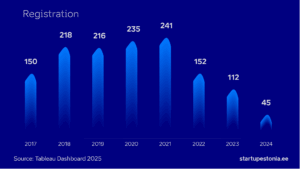
Currently, there are a total of 1,566 startups in the Estonian sector, of which 1,321 (84%) are economically active according to EMTA data; also, about 50 companies are in a problematic state, such as liquidation or bankruptcy. There is a clear trend in the decline of the number of registrations, which has been ongoing since 2022. The startup sector is maturing, though it remains relatively young: the average age of the companies is about 7 years old. Important note: the EMTA data concerns only economically active companies, therefore, according to EMTA the number of people currently employed in the economically active companies of the startup sector is 15 011, while for the Department of Statistics, the number of employees for all companies in the sector is 17082.
Employment
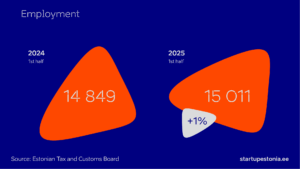
The top 10 employers exhibit varied employment trends from 2024 to 2025, with an overall modest net growth driven by expansions in most firms offsetting declines in a few. Leaders like Wise and Bolt continued to scale, adding 178 and 80 employees respectively for 9% and 6% increases, while high-growth standouts Veriff and Milrem Robotics surged by 28% and 39% (adding 71 and 90 staff). However, Playtech and Swappie saw reductions of 1% and 25% (losing 10 and 118 employees), potentially reflecting optimization or market challenges. Mid-tier players such as Yolo (Heathmont), Microsoft Development Center, Pipedrive, and Coolbet showed steady gains of 2-11%, indicating a maturing ecosystem focused on targeted hiring amid economic caution.
Demographics
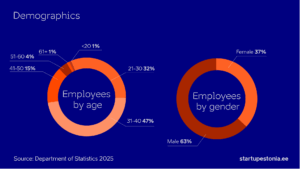
The Estonian startup sector’s workforce, totaling 17,082 employees, is heavily skewed toward younger and middle-aged professionals, with the 31-40 age group dominating at 47% (8,088 individuals) and the 21-30 bracket at 32% (5,413), together accounting for nearly 80% and highlighting its appeal to millennials and early Gen Z through innovative tech roles and dynamic environments; however, gender distribution remains imbalanced at 37% female and 63% male, while education levels are high, with 37% holding Bachelor’s degrees (ISCED 6), 30% Master’s (ISCED 7), and 2% Doctoral (ISCED 8).
Among founders, the profile is predominantly male (83% vs. 17% female) and middle-aged, with 46% aged 31-40, 41% over 41, and just 13% under 30, suggesting a maturing base with strong experience but potentially less youthful innovation; education is advanced, as 40% possess Master’s or PhD degrees (ISCED 7-8) and 26% vocational or Bachelor’s (ISCED 5-6), while citizenship shows a local core (59% Estonian) with international diversity (20% non-EU, 4% EU, 17% unknown).
State and Labor Taxes revenue
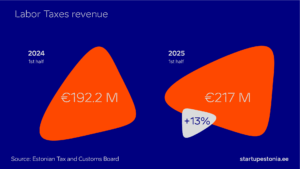
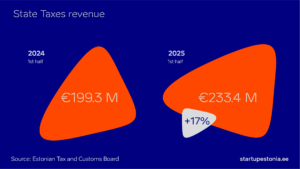
The Estonian startup sector’s state and labor taxes in the first half of 2025 showed solid growth, with overall state taxes rising 17% from €199.3 million in H1 2024 to €233.4 million, and labor taxes increasing 13%, which reflects an improved profitability and growth of wages despite the modest workforce expansion. The stability in shares despite tax revenue growth reveals a proportionally balanced expansion across all age groups, where accelerated contributions from emerging firms are matched by the reliable growth in older ones, revealing a resilient startup ecosystem with proportionally growing tax contributions.
Turnover
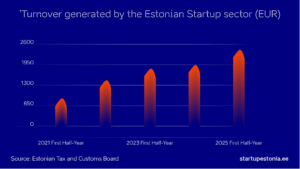
The turnover in the Estonian startup sector for the first half of each year shows a pattern of strong initial growth followed by a slowdown and a recent rebound. Starting from €876.6 million in H1 2021, it surged by 67% to €1.467 billion in H1 2022, reflecting a post-pandemic boom. Growth moderated to 26% in H1 2023 (€1.854 billion), indicating sustained momentum but at a reduced pace amid global economic uncertainties. By H1 2024, the increase slowed dramatically to just 5% (€1.941 billion), suggesting growing economic challenges. However, H1 2025 saw a robust recovery with 25% growth to €2.421 billion, signaling renewed adaptation and resilience of the sector.
The top five Estonian startup sector companies by H1 2025 turnover—led by Bolt at €837.4 million, followed by Pipedrive (€191.3 million), Wise (€80.2 million), BetPawa (€56.3 million), and Veriff (€52.5 million)—demonstrate a concentrated revenue landscape where mobility and fintech players dominate, accounting for over 80% of the group’s €1.2 billion combined. This lineup reflects the sector’s maturation, with unicorns like Bolt and Wise leveraging global scaling for sustained leadership, while SaaS (Pipedrive), gaming (BetPawa), and identity tech (Veriff) add diversification. Even though a heavy reliance on a few heavyweights accounting for 50% of the entire startup sector’s turnover signals potential vulnerability to market shifts, it also emphasizes Estonia’s prowess in exporting high-value digital services, contributing to the ecosystem’s 25% year-over-year growth amid broader economic headwinds.
Investments and exits
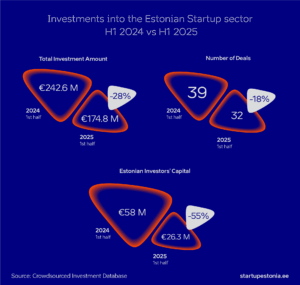
Investments in the Estonian startup sector trended downward in H1 2025, with total funding at €174.8 million across 32 deals, a 28% drop from €242.6 million and 39 deals in H1 2024; Estonian investors contributed just €26.3 million, down 55% from €58 million the prior year, signaling caution despite rising sector turnover and tax revenues. This sharp drop in startup investments contrasts with broader Estonian economy trends, where Statistics Estonia reported a slight 0.3% year-over-year investment decrease in Q2 2025, driven by an 8.1% fall in non-financial corporations but offset by 10% gains in financial corporations, government, and households, particularly from increased government spending on machinery, equipment, and weapons systems.
Shifting investor focus favored younger companies, with those under 5 years old capturing 81% of funding (€141.9 million across 24 deals) in 2025, up from 44% in 2024, while Deep Tech led with €88.3 million (51% of total, 13 deals) despite comprising only 11% of the sector, and visa-linked firms secured €74.2 million (42%, 7 deals), highlighting international talent’s role. Exits remained subdued but notable: Q1 saw acquisitions of Promoty (January), Parcelsea and Fiizy (February), Adact and Ridango (March); Q2 featured Video Game Insights by U.S. Sensor Tower (April) and Clevon by Indigo Technologies (May), underscoring Estonia’s appeal for global niche tech buys.
Startup Visa
The situation with startup visas in Estonia has shifted from 2024 to 2025, pointing toward a decline in the total number of companies receiving them, as the total number currently stands at 18, while at the end of 2024 it was 27. Nonetheless, the decline might not be as sharp as the year is not over. The proportion of visas for talent increased significantly from 52% to 78%, suggesting a greater emphasis on attracting international employees to support existing operations. In contrast, visas for founders decreased from 37% to 22%, and ScaleUp visas became minimal over the three-year period. Overall, while cumulative figures remain steady at 329 for talent, 235 for founders, and 16 for ScaleUp, the yearly trend points to a contracting pipeline for new visa-backed companies, potentially impacting long-term ecosystem growth.
DeepTech
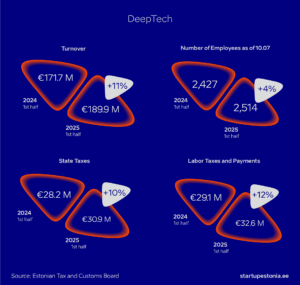
The Deeptech industry in Estonia demonstrates steady growth across key metrics from the first half of 2024 to 2025, with turnover increasing 11% from €171.7 million to €189.9 million, reflecting robust revenue expansion possibly driven by innovation in areas like AI, biotech, or advanced manufacturing. Employment also rose slightly by 4%, from 2,427 to 2,514 workers as of July 10, indicating targeted hiring amid a maturing sector. Fiscal contributions strengthened, with state taxes up 10% from €28.2 million to €30.9 million and labor taxes and payments climbing 12% from €29.1 million to €32.6 million, suggesting higher wages or profitability per employee despite the moderate workforce growth. Overall, this data points to a resilient Deeptech segment of the sector prioritizing efficiency and value creation over rapid scaling.
Conclusions
The first half of 2025 reveals an Estonian startup sector that is resilient amid economic challenges, marked by a robust 25% turnover growth and rising tax contributions driven by efficiency gains and higher revenue per employee in a maturing ecosystem led by established firms. Employment inched up by just 1%, signaling a shift toward optimization rather than expansion, while younger companies delivered dynamic revenue surges but grappled with workforce reductions and a shrinking influx of new ventures since 2022. Investments dropped 28%, reflecting local caution in a pessimistic climate, yet Deep Tech’s dominance and young firms’ 81% funding share highlight targeted innovation bets.
Demographics underscore a highly educated, middle-aged talent pool with stark gender imbalances—83% male founders and 63% male employees—coupled with modest international diversity, as visa programs increasingly prioritize skilled workers over new entrepreneurs. Exits, though sparse, confirm Estonia’s draw for global tech buyers.
Ultimately, this data highlights a sector evolving toward sustainable maturity rather than explosive youth, but sustained vitality hinges on policy support for fresh entrepreneurship, focused investment and foreign talent to counter demographic and investment slowdowns.
Authors: Ivan Polynin, Kristi Õras (both Startup Estonia)
Sources:
EMTA. 2025. Statistics and Open Data
Tableau Public. Startup sector by Enterprise Estonia
Tableau Public. Startup Sector companies
Department of Statistics 2025. Demographics, salary, GDP, R&D investments (ordered based on the Startup Sector company list)
Eesti Pank, 2025 Q1, Q2 reports