Stability is the New Speed: Estonian Startup Sector in Q1 2025
For an industry known for moving fast and breaking things, Estonia’s startup sector had a relatively composed start to 2025. No dramatic pivots, no unicorn stampedes—just the kind of steady, behind-the-scenes shifts that hint at something deeper: maturity. With hiring patterns flattening, investment numbers wobbling, and turnover climbing in unexpected corners, the ecosystem is giving us plenty to read between the lines. Let’s get into it.
Employment and Taxes: Growing pains, quietly managed
It’s no secret that headcounts aren’t climbing the way they used to. According to data from the Estonian Tax and Customs Board, Estonia’s startup sector employed 14,285 people locally as of the end of Q1 2025—just a touch below last year’s number (14,358). A 0.5% dip isn’t dramatic, but it’s worth noting. What we’re seeing isn’t a collapse. It’s a quiet recalibration.

Beneath the surface, a more nuanced picture emerges. Startups up to five years old and full-fledged scale-ups both added talent—2% and 5% growth, respectively. Meanwhile, companies in the 6–10-year age range slimmed down by 3%. These shifts reflect trends from 2024, indicating a deeper structural balance within the ecosystem.
And yes, the big names still loom large: nearly half (45.7%) of all startup employees work at just ten companies. Wise leads with 2,050 team members, followed by Bolt (1,320), Playtech (657), Yolo (562), and Swappie (416). The usual suspects. The heavy lifters.
But the weight isn’t just in warm bodies—it’s in taxes too. Despite employment leveling off, employment tax contributions rose to €99.7 million in Q1 2025, up 11% from Q1 2024 and 9% from Q4. Bolt, Wise, and Yolo top the list here as well. So, while hiring slows, the fiscal footprint grows. That’s resilience with a revenue stream.

Meanwhile, OSKA’s 2025 labour market report reminds us of a longer-term constraint: Estonia’s working-age population is shrinking. The solution? Open the doors wider. Foreign specialists are already essential in roles like software development, customer success, and financial analysis—and many are here thanks to quota exemptions. For startups, this isn’t a nice-to-have. It’s mission-critical.
Turnover, Investments & Exits: Big moves, quiet confidence
If Q1 2025 had a headline, it might be: “Startups go big, quietly.” While investment chatter cooled and exits slipped under the radar, Estonia’s startups were busy doing what they do best-delivering.
Total sector turnover hit €1.22 billion, a solid 40% increase over Q1 2024. That’s not a typo. In a national economy where average turnover growth hovered around 5%, the startup sector once again pulled away from the pack.
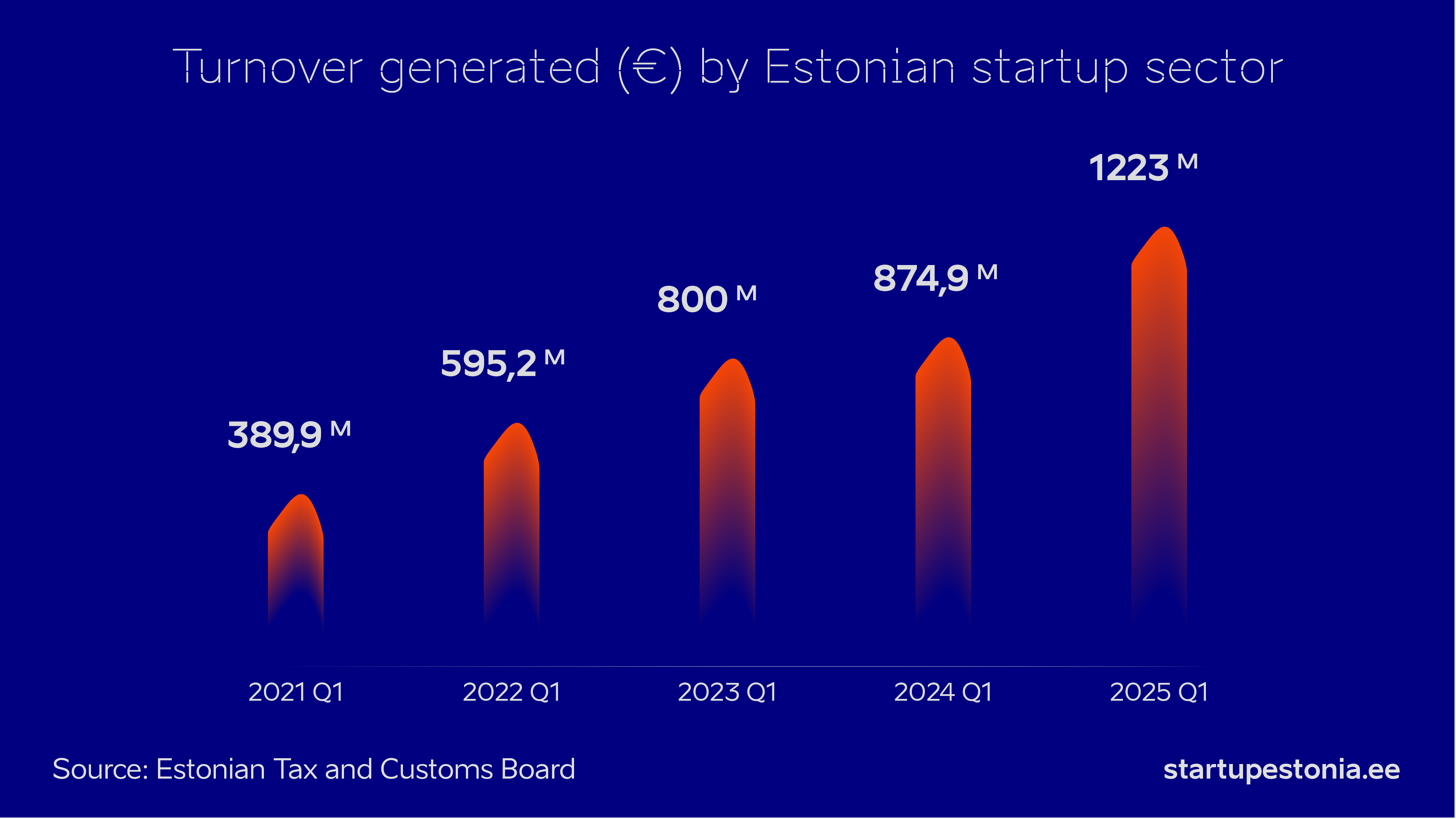
Where’s that growth coming from? Predictably, mature companies—scaleups and 10+ year veterans—are doing the heavy lifting, bringing in 57% of total turnover. But the real energy? It’s bubbling up from the bottom. Startups aged 0–5 years clocked a 61% turnover increase, and scale-ups weren’t far behind with +45%. Translation: the next generation isn’t just knocking—they’re scaling.
Among individual companies, Bolt led the charge with €405.4 million, making up a third of the sector’s total turnover. Pipedrive followed with €121M, while Wise (€34.8M), BetPawa (€32.8M), and Sunly (€29M) rounded out the top performers.
Note: turnover figures are sourced from the Estonian Tax and Customs Board data, so don’t confuse them with annual financial reports—they’re a different lens entirely.
Investments: Fewer deals, but no panic
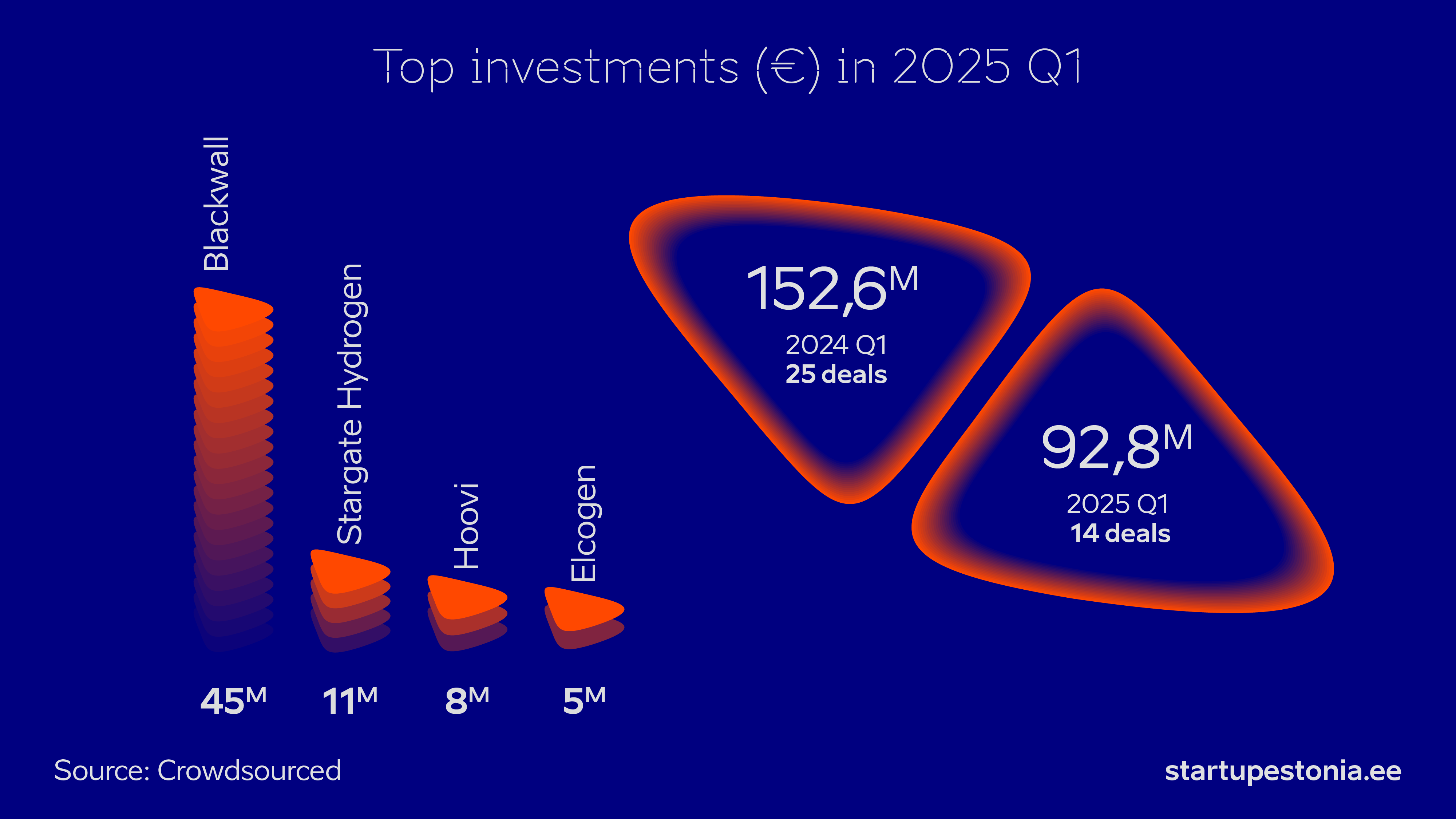
Yes, investment volumes dropped. No, it’s not a crisis. According to the crowdsourced table, Estonian startups raised €92.8 million across 14 deals in Q1 2025—down from €152.6 million and 25 deals in Q1 2024. That’s a 39% drop in funding, and a 44% dip in deal count.
But here’s the twist: 11 of the 14 deals were over €1 million. Investors may be making fewer bets, but they’re still backing bold. Blackwall landed the biggest round with €45M, followed by Stargate Hydrogen (€11M), Hoovi (€8M), and Elcogen (€5M). Not bad for a “slow” quarter.
And while the number of deals dropped, early-stage momentum didn’t: startups aged five years or less raised approximately €73 million—around 70% of all capital raised in Q1 2025. That’s not just a vote of confidence. It’s a signal that the pipeline is alive and well.
And remember, not every deal makes the headlines on time. More rounds may surface retroactively. The final Q1 tally could still climb.
Exits: Subtle, strategic, and still rolling
On the exit front, the action was under the radar—but meaningful. Promoty was acquired by Modasch in January. Parcelsea joined Ukraine’s Jetbeep in February. That same month, Fiizy found a new home under fintech group Clar. In March, Adact was snapped up by a US-Israeli company that plans to open a Tallinn dev hub. And Ridango? Majority stake acquired by Bregal Milestone, a global private equity player.
No IPOs, no unicorn fireworks—but a steady rhythm of exits that quietly reinforces one thing: Estonia remains a seller’s market for global innovation buyers.
DeepTech: Quietly building the future
Far from the mainstream spotlight, Estonia’s DeepTech sector is making the kind of breakthroughs that power industries, not just ideas.
In Q1 2025, DeepTech startups in Estonia pulled in €100 million in turnover, paid €16.2 million in employment taxes, and employed 2,415 people locally—around 17% of the entire startup workforce. That’s not just “deep”—it’s deeply integrated.
And it’s not just about cool tech—it’s about traction. Milrem led the pack with €18.8M in turnover, followed by Defsecintel (€17.5M), Threod Systems (€8.6M), Starship Technologies (€6,1 M), and Cleveron (€5.9M). These aren’t science experiments. They’re export-ready, revenue-generating businesses rooted in real-world applications—from defense and robotics to automation and green energy.
On the funding front, DeepTech continues to punch above its weight. In Q1, the sector raised €23.4 million across five deals—a solid 23% of all startup sector investments in Estonia. The standouts? Stargate Hydrogen with €11M, Elcogen with €5M, and Frankenburg Technology with €4M. Others like Gridio (€2.4M) and Galttec (€1M) also joined the list, each working on technology that could shape entire industries.
Compared to Q1 2024, total DeepTech funding is down nearly fourfold. But context matters: last year’s results were significantly boosted by Starship Technologies’ €90M megadeal—an outlier that inflated the quarterly totals. Without that spike, this year’s €23.4M still signals strong momentum in a capital-intensive space that rarely plays in small numbers.
A European tailwind
This isn’t happening in a vacuum. According to the 2025 European Deep Tech Report, DeepTech is now the most funded startup sector in Europe, beating fintech and life sciences. In 2024, DeepTech scooped up 28% of all VC funding, up from just 11% a decade ago.
Even in a cooling market, DeepTech has held its ground. Traditional tech funding plummeted by 60% since the 2021 peak. DeepTech? Down just 28%. It’s not just resilient—it’s becoming the new default for serious long-term bets.
The frontier areas—AI, quantum, robotics, hydrogen, next-gen energy—aren’t optional for Europe anymore. And Estonia, it turns out, is in the game. The takeaway? DeepTech isn’t a niche. It’s a national asset.
Summary: Not chasing hype. Building what lasts.
There’s more than one way to grow—and Estonia’s startup sector is choosing the long game. The numbers from Q1 2025 don’t shout for attention, but they tell a story of quiet consolidation, measured adaptation, and structural resilience.
Hiring might be slowing, but productivity is rising. Investment flows have narrowed, but they’re sharper. Younger startups are accelerating. Older ones are holding the line. And DeepTech? It’s stepping forward with purpose—and performance.
No fireworks. No panic. Just a sector that’s maturing into something rare in the startup world: stability without stagnation. In Estonia, that’s not the end of the story—it’s the foundation for what comes next.
Authors: Moonika Mällo, Ettie Mikita (both Startup Estonia)
Sources: Startup Estonia, Statistics Estonia, Estonian Tax and Customs Board, Dealroom, Funding of Estonian Tech Startups #estonianmafia
Startup Estonia is a program under Enterprise Estonia that develops the Estonian startup ecosystem. The program (project number 2021-2027.1.03.23-0212) is financed by the European Union.