Overview of the Estonian DeepTech Ecosystem 2023
The development of Estonia’s knowledge-based DeepTech ecosystem began in 2020 when Startup Estonia published the strategic document “White Paper 2021-2027.” This document aimed to increase the focus on supporting research and technology-intensive startups, known as DeepTech startups. It also aimed to enhance coherence with the priorities of the research and development innovation and business development plan (TAIE). To initiate this area, Startup Estonia developed a DeepTech action plan for 2023-2027, focusing on five key development areas:
- Human Resources: Supporting the development of founders, employees, and other key roles.
- Ecosystem Skills Development: Enhancing the knowledge and skills of ecosystem participants.
- Capital Market Development: Promoting investment opportunities.
- Networking Opportunities: Increasing cooperation and cohesion within the ecosystem.
- Business Environment Development: Creating a business-friendly environment.
The goal of these activities is to create a favorable environment for DeepTech entrepreneurship and support the global impact growth of Estonian startups. By 2030, the aim is to have 500 DeepTech companies operating in Estonia, accounting for about 30% of the startup sector’s total volume. Startup Estonia prepares annual interim reports to monitor this goal, reflecting ecosystem developments and needs.
Sector overview
According to the Estonian startup ecosystem platform Dealroom, as of 31 December 2023, there were 132 DeepTech startups and 12 growth or mature companies operating in Estonia. In 2023, there were 3 exits in the field (ParcelSea, Milrem Robotics, AmplerBikes), and 1 company, Eurora Solution, ceased operations due to bankruptcy.
According to the Estonian Tax and Customs Board, in 2023, DeepTech startups paid 88.5 million EUR in state and labour taxes (20% more than in 2022), had a total revenue of 227.2 million EUR (14% more than in 2022), and employed 1963 people by the end of the year. The largest labour tax payers in 2023 were Milrem Robotics (4.6 million EUR), Starship Technologies (3.7 million EUR), Cleveron (3.6 million EUR), Skeleton (3.3 million EUR), and Comodule (2.8 million EUR).
In 2023, there were 28 investments in the DeepTech sector, with 11 companies having female co-founders (39%). The total transaction volume was 254 million EUR, accounting for 65% of the total value of startup sector investments, which amounted to 394 million EUR. Compared to 2022, there was a 16% increase where 216 million EUR was raised. The largest investment recipients were Skeleton Technologies with 158 million EUR and Elcogen with 45 million EUR. Among early-stage companies, the largest investments were raised by Efenco (12.3 million EUR), RAIKU (8.8 million EUR), and others.
Among the DeepTech companies registered in Estonia, 25% report owning intellectual property, and 7% of the entire business sector reports research and development expenses, which are critical for both long-term growth and the ability to attract necessary capital.
The Estonian DeepTech startup sector is still relatively young, as 70% of operating companies have been founded in the last five years. Most DeepTech companies were established between 2018-2021 (81 companies). Although 22 new companies were created in 2021, the pace of company formation has slowed in subsequent years, which may be due to a cooling of the economic environment.

Although the emergence of new companies has slowed, by the end of 2023, the sector’s companies accounted for 8% of the entire startup sector in terms of revenue and number. Notably, 90% of the total revenue of DeepTech startups (204.9 million euros) was generated by 21 companies, which represent 15% of all companies in the sector. All of these companies had an annual revenue exceeding one million euros, with the highest revenues reported by Cleveron AS (30.3 million euros) and Defsecintel Solution (27.7 million euros). Skeleton Technologies, despite being known for a large-scale investment, had a revenue of 5 million euros in Estonia.
While the revenue of DeepTech companies constitutes 8% of the entire startup sector, their share of state and labour taxes reached 14%. This highlights the high costs associated with product development in DeepTech companies and the relatively higher proportion of high value-added labour.

Assessment of the Current State of the Ecosystem
To gain a more detailed overview of the current state of the ecosystem, Startup Estonia conducted a survey among 130 DeepTech companies in November-December 2023 and mapped out the active services and programmes offered on the Estonian market. The aim was to take an in-depth look at the current situation and provide an evidence-based overview of market participants’ expectations and current opportunities to assess whether ecosystem development activities are on the right track and up to date.
Entrepreneurs’ Assessments
Of the aforementioned survey, 31 companies responded, resulting in a response rate of 25% (out of the 130 companies that received the survey). The responding entrepreneurs mainly came from the following technology sectors: Climate/Energy (29%), Advanced Manufacturing (22.6%), and Health & Life Science (22.6%). In terms of growth stages, most respondents were in the Product-Market Fit stage (32.3%) and the Minimum Viable Product stage (29%). Based on the founding years of the companies, 68% of respondents, or 21 companies, were up to 5 years old, confirming the youth of the Estonian DeepTech sector.
The survey focused on the availability of human resources, i.e., employees and talent, access to capital, and expectations for ecosystem development activities. The survey’s structure considered the survey conducted by the Founders Society among startup founders in the summer of 2023 to compare the state of the DeepTech sector with the general startup scene. In addition to determining the current situation and expectations, we asked entrepreneurs to highlight what motivated them to establish a DeepTech company. Overall, entrepreneurs were driven by personal motives, societal needs, and the desire to solve complex problems.
Among the motivations for establishing a company, the following were mentioned:
- Identifying and solving market problems with innovative technologies, aiming to have a significant positive impact on the world.
- Leveraging legislative changes and global events, such as health crises and climate change, to create new opportunities.
- Applying academic knowledge or applied research to practical use.
- Personal missions such as environmental protection or addressing health issues.
- Seeking self-fulfillment, taking on challenges, and the desire to achieve financial success.
The general factors influencing the positive development of the company were identified as follows:
- A strong entrepreneurial culture and advice from successful founders.
- Access to resources, including sufficient funding for rapid development and hiring skilled labour.
- Recognition and encouragement to engage in knowledge-based entrepreneurship and global trends towards green and deep technologies.
- A strong team, early investors, and a robust research and development network.
- Support from government institutions and openness to new technologies.
The most cited challenges for company growth were difficulties in attracting investments (considered the most challenging by 68% of respondents), followed by the lack of accessible workforce (52%), and thirdly, the constraints of the regulatory environment (36% of respondents).
People – employees, founders
The average number of employees in the DeepTech startups that responded to the survey was 11 people, with a little over half of the companies employing foreigners, averaging 3 foreigners per company. Among the responding companies, 39% had ten or more team members, and 33% had a team of up to 4 members.
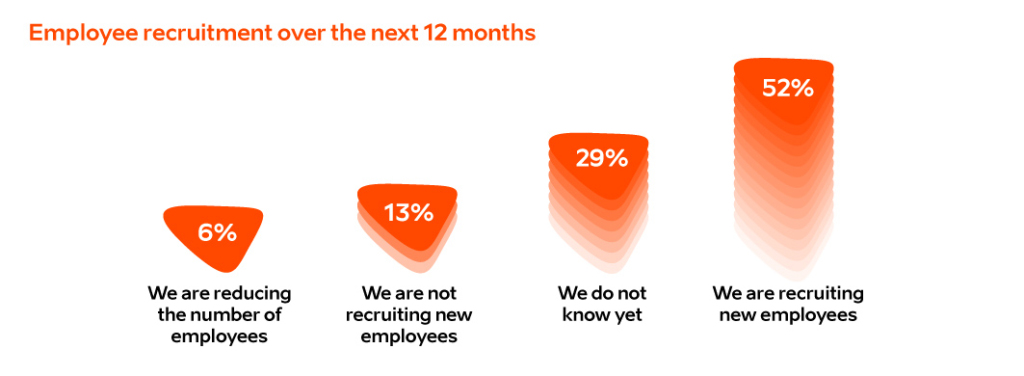
According to the results of a startup sector-wide survey conducted in the summer of 2023 (Founders Society report), more than half of the respondents planned to increase their team size in the next 12 months, and only 4% planned to reduce their team. A similar distribution is observed among DeepTech startups. The majority of the survey respondents plan to increase their team size in the next 12 months (52%), and 6% plan to reduce their team size.
The majority of the responding companies (54.8%) had three or more vacant positions. The most unfilled positions in DeepTech startups are in business development and sales (51.6%) and developer roles (45.1%). Additionally, 32% of respondents had vacancies in customer support, domain expert, or financial manager positions.
Many respondents indicated that the lack of qualified labour significantly impacts company growth. For 12.9% of respondents, it was the biggest obstacle to growth, and for 28.7%, it was the second biggest challenge after access to finance.
Companies were asked to compare talent availability in Estonia with the Nordic countries, and 58% of respondents rated finding suitable talent in Estonia as very difficult or rather difficult compared to the Nordic countries. Not a single company rated talent availability in Estonia as easy.
To the question of how to improve talent availability in Estonia, several different suggestions were made. Common themes in the responses included:
- Offering better tax incentives.
- Simplifying access to highly qualified labour (both within Estonia in cooperation with universities and through the involvement of foreign talent).
- Increasing awareness of science-intensive fields and improving the quality of education.
- Improving the quality of the life and work environment.
Funding
According to the survey, 64.5% of respondents have raised investment capital for company growth, with the average investment size being 3.7 million EUR. Of the investments raised, 67% are in the minimum viable product phase, i.e., early-stage DeepTech companies, and 29% are in the product-market fit phase. One-third of the DeepTech companies that responded to the survey noted that their last funding round took place in 2023.
According to the results of the Founders Society’s sector-wide startup survey, 23% of respondents planned to raise funds in the next 12 months, and 7% of respondents believed they would fail to raise capital.
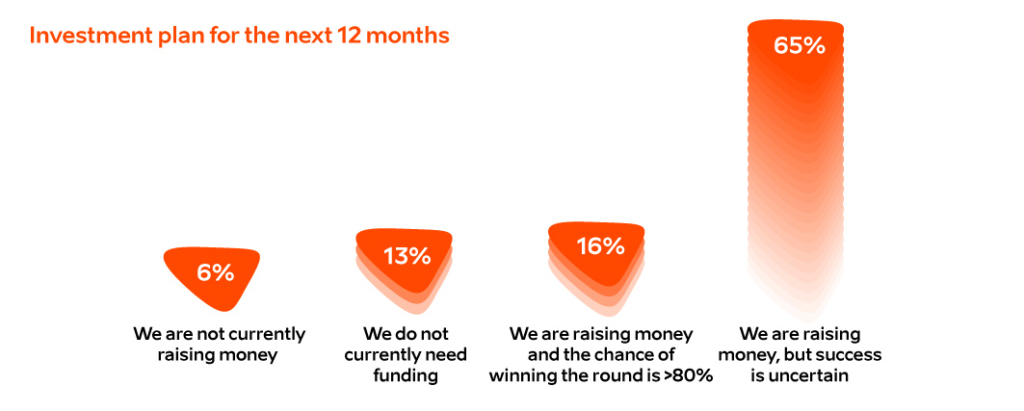
The survey results among DeepTech startups show that 80.6% of respondents planned to raise funds in the next 12 months. However, the majority (64.5% of respondents) were uncertain about the success of raising funds, with 16.1% of respondents being optimistic about the likelihood of securing funding.
For 2024, the most important focus for respondents is raising funds (74.2% of respondents considered this the most important). Other focuses included increasing sales (58.1%) and product development (54.8%).
According to 64.5% of respondents, investor sentiment towards investing in DeepTech companies has become more pessimistic over the past year. A similar assessment was drawn from the sector-wide startup survey conducted by the Founders Society during the summer.
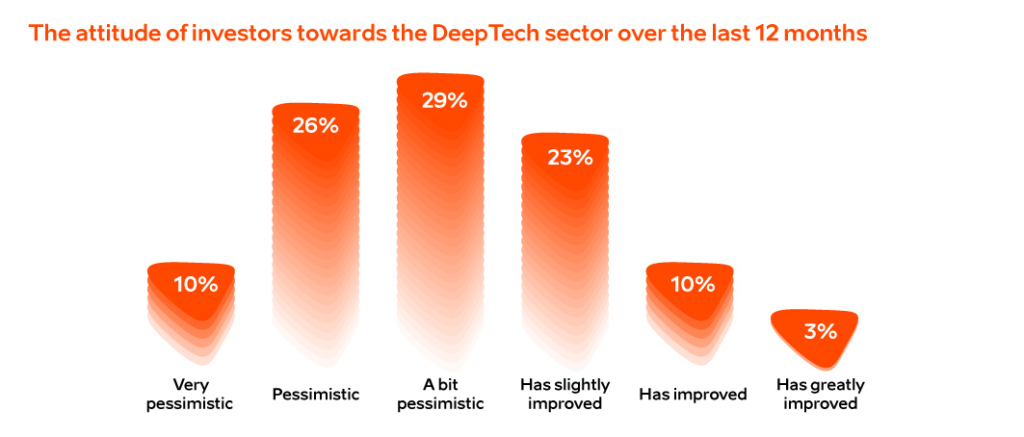
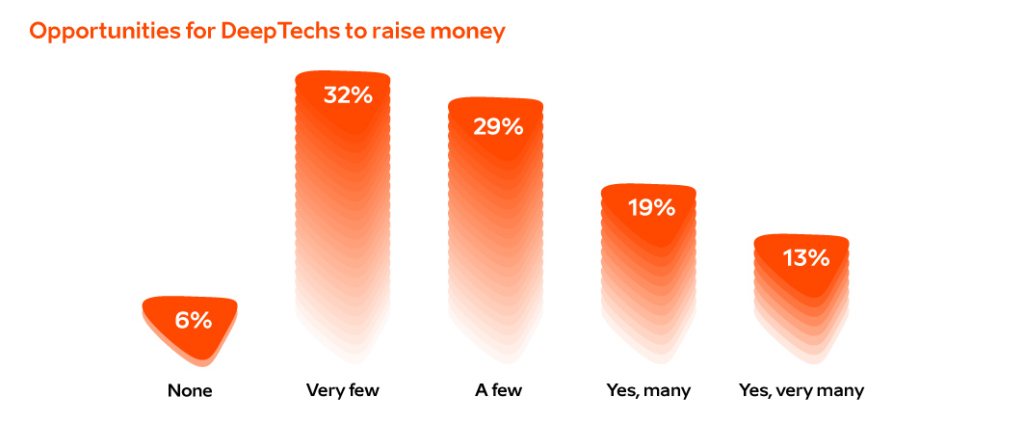
The pessimistic attitude of investors is also reflected in the DeepTech entrepreneurs’ assessments of the feasibility of raising funds. As many as 68% of respondents rate their chances of raising capital as low or very low based on their experience. This lack of opportunities indicates either investors’ limited awareness of companies solving complex problems, significantly longer timeframes to reach the market, or the companies’ own inabilities to secure funding.
Overall, the DeepTech companies’ assessments of their runway, or the continuation of funds for operations, are more pessimistic than those of the surveyed startups in the sector-wide survey. At the current level of spending, 61% of respondents have a runway of up to 1 year, and 19% have funding that will last for more than 2 years.
Networks
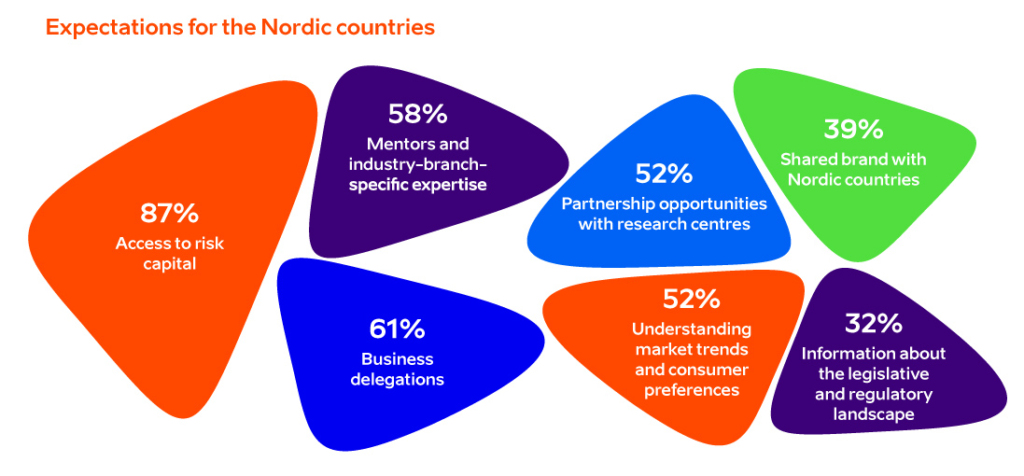
Entrepreneurs were asked about their expectations for doing business in the Nordic countries in terms of knowledge transfer and network expansion. The most important factor was increasing access to venture capital (87.1%), followed by opportunities for business missions to raise the company’s visibility (61.3%). Finding industry-specific experts or mentors was considered the third most important factor (58.1%), achieved through developing collaborative relationships with leaders in the Nordic industrial sectors and universities.
Business Environment
To improve the business environment, DeepTech companies expect assistance from the government primarily in the form of technology development and business development grants, with 56.7% of respondents considering the availability of public sector support to be one of the most important aids, valuing it slightly more than product development support. This was followed by direct investments and access to funding through venture capital funds, with 53.3% of respondents considering these needs to be the most important in both cases. As a fourth priority, 33.3% of respondents considered investment return guarantees for investors to be one of the most important forms of support. A significant 83.3% of respondents believed that the DeepTech ecosystem cannot thrive without government support, indicating a strong expectation for support of DeepTech startups, especially in the early stages.
DeepTech companies expect the following most from Startup Estonia:
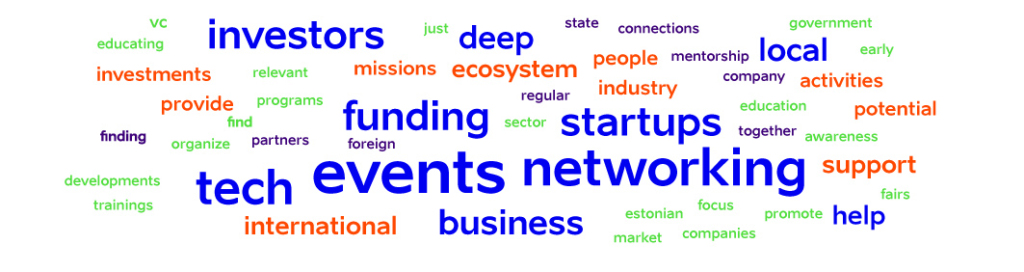
- Networking events: regular events, connecting people, pitching opportunities, mentoring, and introducing the ecosystem.
- Creating opportunities for finding capital: assistance in securing funding and talent, and establishing contacts with foreign partners.
- Marketing: international marketing of the sector and companies, creating collaboration opportunities, and supporting participation in events.

In addition to the entrepreneurs’ assessments, their expectations can be vividly summarised in a word cloud, highlighting networking opportunities and funding-related expectations:
Support Services in the DeepTech Companies Ecosystem
Supporting the growth of DeepTech startups requires appropriate services and programmes. According to the 2023 mapping, there are currently about 100 different services suitable for DeepTech startups in Estonia, including accelerator and mentorship programmes, incubation programmes, venture capital funds, networking events, and grants. As of 2023, there are 35 growth-supporting services specifically suitable for DeepTech companies, seven of which are offered by Enterprise Estonia (EIS).
In mapping the services, we based them on the company lifecycle, dividing them into six different growth phases to identify gaps in the available services.
- Idea Phase (Idea, research) – generating ideas and conducting initial research.
- Pre-startup Phase (Pre-startup, pre-seed) – validating the business idea with mentorship support and developing the initial business model.
- Startup Phase (Startup, seed) – product development, market entry, initial customer acquisition, and access to initial capital.
- Early Growth Phase (A-B round) – scaling the business model and accelerating growth, including attracting large-scale investments.
- Growth Phase (C+ round) – international expansion, securing market position, and forming strategic partnerships.
- Maturity Phase (Matured) – sustainability, supporting innovation, and developing new markets.

The mapping results revealed that most services are offered to companies in the startup lifecycle phase, meaning those that have already established a business entity and whose product or service has reached Technology Readiness Level 5 (TRL 5 – technology validated in a relevant environment). In the early development phase of startups, universities and science parks are the main providers of services and programmes that support the emergence of spin-off businesses from basic science. However, there is a significant lack of seed funding opportunities or small grants for prototype creation in the idea phase.
To develop the DeepTech ecosystem more broadly, Startup Estonia co-financed the following pilot initiatives and short-term projects in 2023, which have the potential to become regular programmes with the acquisition of permanent funding:
- DeepTech Sandbox event series to bring international experience to Estonia – aimed at showcasing how top universities in the world (Technical University of Denmark, Cambridge, and Eindhoven University of Technology) promote spin-off entrepreneurship. The development programme was implemented by Tallinn University of Technology, Tallinn Science Park Tehnopol, and the Estonian Business Angels Association. More details, including a summary report, can be found here.
- DTx development programme for startups offering software-based medical devices. The programme was conducted by DTx Estonia.
- Entrepreneurship residency pilot programme with two research teams and an entrepreneurship resident. The programme was carried out by the Entrepreneurship and Innovation Center of the University of Tartu.
- In cooperation with the Applied Research Programme, we commissioned a study titled “Deep Technology Development Trajectories and Their Significance for Estonia.” The study was conducted by Tallinn University of Technology and Civitta. The study and summary reports can be accessed here.
In 2023, activities aimed at the internationalisation of DeepTech startups were initiated or continued:
- NATO Diana accelerator and NATO Innovation Fund
- CDL Estonia accelerator for growth companies
- UniTartu Ventures
- European Space Agency Business Incubation Centre (ESA BIC) programme
For comparison with the mapped services, we asked entrepreneurs in the survey which services have most supported their growth so far.
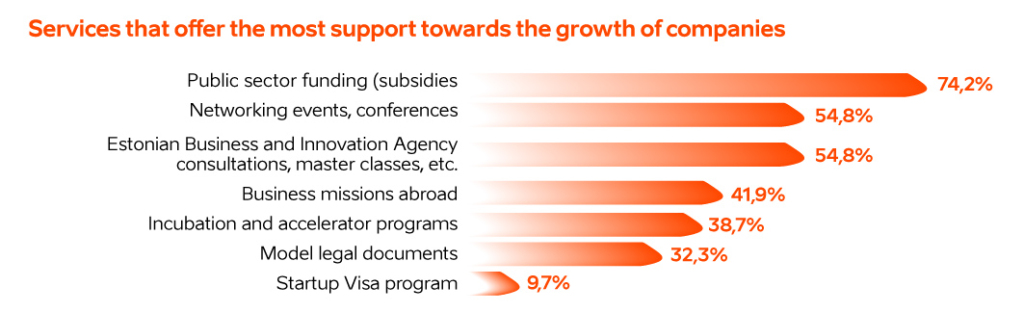
Although entrepreneurs did not strongly highlight issues related to intellectual property protection, it is important to provide more guidance on this topic to entrepreneurs and university researchers. The perceived lack of importance indicates a low level of awareness regarding the legal protection of inventions and the management of registered patents. The lack of awareness about intellectual property protection is vividly illustrated by a chart compiled by Rainis Venta, which provides an overview of Estonia’s position compared to other countries:
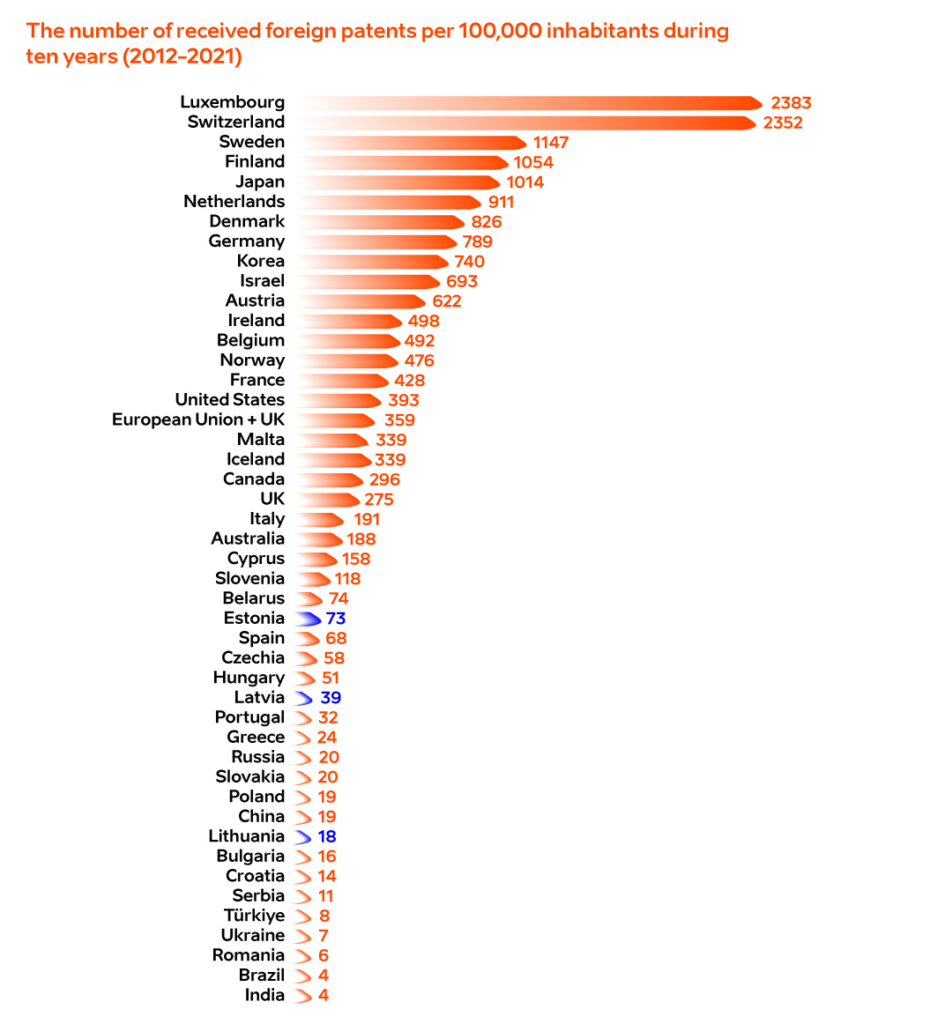
In 2024, EIS plans to continue supporting company growth through advisory services, business missions, and funding for business development and expansion into new markets. The focus will be on intellectual property, including model documents and training programmes, the launch of the Nordic Technology Valley, the expansion of the entrepreneurship residency, and the introduction of an operational model in the health technology and services sector through a large-scale government procurement.
Summary of Services and Expectations for the DeepTech Sector Ecosystem in 2023
Based on the 2023 analysis, three main bottlenecks were identified that should be considered for further ecosystem development. The main bottlenecks are:
- Slowing pace of new company formation: The creation of new deep technology companies has decreased due to the cooling economic environment and lack of motivation.
- Shortage of qualified workforce: Finding specialists with the appropriate qualifications is challenging, especially compared to the Nordic countries.
- Challenges in attracting funding: Although the sector has a large volume of investments, raising capital remains one of the main growth constraints.
Calculation of Capital Market Needs:
- In 2023, the total investments in the DeepTech sector amounted to 254 million euros. This sum includes all transactions, both for mature companies and startups.
- Average Investment Per Company: If we divide the total investment amount for 2023 (254 million euros) by the number of existing companies (132), we get an average investment size per company of approximately 1.92 million euros.
- Estimated Required Investment Volume for 368 New Companies: Assuming each new company requires the same average capital as in 2023, 368 new companies would need a total of 706.6 million euros.
This calculation provides a general understanding of the average capital availability needed in Estonia, which is 100 million euros per year, to ensure DeepTech companies can grow and create higher added value for the economy. However, it is important to note that this is a simplified estimate and actual needs can vary significantly depending on many factors, such as:
- Variation in Capital Needs: The need for capital can vary greatly depending on factors such as the sector, technology maturity, market readiness, and individual company needs.
- Economic Environment and Market Conditions: A changing economic environment and market conditions can also affect the size and needs of investments.
- Funding Sources: Sustainability and growth funding sources can include not only private capital but also government grants, European Union grants, strategic investments, and other funding methods, which can affect the amount required per company.
In addition to securing capital needs, the following activities can have the greatest impact on the creation and growth of companies:
- Regulatory Advice and Support: DeepTech companies often operate in sectors where regulatory requirements are complex and changeable, such as biotechnology, healthcare, energy, and high-tech materials. These sectors often require long-term testing and regulatory approval to bring products to market. Regulatory advice and support can significantly accelerate product development processes and market entry by helping companies:
- Navigate the Regulatory Environment: Assistance in understanding regulatory requirements and developing compliance strategies.
- Reduce Time to Market: Accelerate the product development cycle by reducing the time and resources needed to overcome regulatory hurdles.
- Mitigate Risks: Avoid potential errors and delays that can arise from non-compliance with regulatory requirements.
- Investor Education and Engagement: Raising investor awareness about deep technologies and their potential market outcomes can increase the willingness to invest in these technologies, which often require larger initial investments and offer higher returns in the long run.
- Workforce Training Programmes: Companies often need specific skills that may not be widely available in the local labour market, especially if these skills are focused on developing highly demanded competencies necessary for increasing innovation and operational efficiency. National or private sector training programmes that focus on specific technical skills or industry specifics can help alleviate skill shortages.
- Support for Export and Internationalisation: Although some networks and accelerators offer support for internationalisation, national programmes could provide more specific services such as export consulting, market research, and advice on local market laws/practices.
- Specialised Intellectual Property (IP) Support: While some services may offer IP consulting, deep technology companies require even more specialised services, such as assistance with patent drafting, strategic IP planning, and protection in a global context.
- Product Validation and Certification Support: Many startups based on deep technologies need to validate and certify their products to enter certain markets or meet industry requirements. National or private sector programmes that assist with these processes can significantly speed up product market entry.
- Crisis Management Resources and Support: Startups may encounter unexpected obstacles or crises, such as lack of funding, significant market changes, or internal issues. A programme that offers management consulting and resources for crisis resolution can help companies better cope and survive.
All these measures contribute to faster growth, but their effectiveness depends on the specific needs and characteristics of the sectors in which companies operate. To ensure a comprehensive approach, combining multiple recommendations should be considered to maximise benefits and accelerate business development. Therefore, attention should also be paid to policy making and the development of a business environment that supports deep technology startups in collaboration with ministries and research institutions.
2024 Development Plans and Planned Activities
In 2023, several topics emerged that we will continue to develop in 2024:
- Amendment Proposal to the Anti-Corruption Act Regarding Restrictions on Researchers’ Actions: This shows efforts to increase transparency in research and development activities and business ethics. Its implementation will help boost trust and investment security, which is particularly important in the deep technology sector.
- Raising Awareness of Intellectual Property: It is important to increase companies’ awareness of intellectual property management, protection, and benefits to enhance their competitiveness on the international stage. This contributes to the growth of companies’ value and the attraction of investments.
- National directive for universities on the emergence of spin-off companies: The support provided by the state for the development of university spin-off companies significantly accelerates the commercialization of new technologies and strengthens the ties between the academic world and industry.
- Supporting the Creation of Technology Scout Positions in Specific Verticals: Utilising technology scouts helps companies identify and implement the latest technological developments, thereby increasing innovation and efficiency. This helps link companies with potential technology sources, such as universities and research institutions.
- Investment Loans and Guarantees for Deep Technology Startups: Increasing the availability of funds through credit options and financial guarantees lowers the risks associated with financing new companies and amplifies their growth and development.
In addition to development topics, the following activities are planned and covered by budgetary funds in 2024 based on the agreed development directions:

In addition to the specific activities mentioned, there is a need in 2024 to map out research teams in universities that have significant potential to become spin-off companies or are currently moving towards establishing a company. This need is confirmed by the low number of new company establishments in the past year and the necessity to ensure deal flow for venture capital firms ready to invest in new deep technologies.
An overview of this potential is provided in the summary compiled by Rainis Venta (University of Tartu, Centre for Entrepreneurship and Innovation) in 2023, which reviews research projects registered in the Estonian Research Information System. These projects operate in the fields of biotechnology, biomedicine, engineering, chemistry, geosciences, and computer science (excluding social sciences and humanities). Across all universities and institutes, there are approximately 1100 research projects in these fields, with an estimated 10% having the potential to commercialise an invention and reach spin-off status.

Therefore, it is crucial to continue supporting universities in promoting spin-off entrepreneurship and spreading the entrepreneurial mindset among the scientific community. The low emergence of new DeepTech companies last year needs to be reversed through collective efforts towards growth. By addressing and strongly developing all other bottlenecks, we can create a robust strategy that not only directs resources and attention to the development of the deep technology sector but also creates a more stable and transparent environment favourable to both existing companies and new entrants.