Knowledge Sharing from the Community
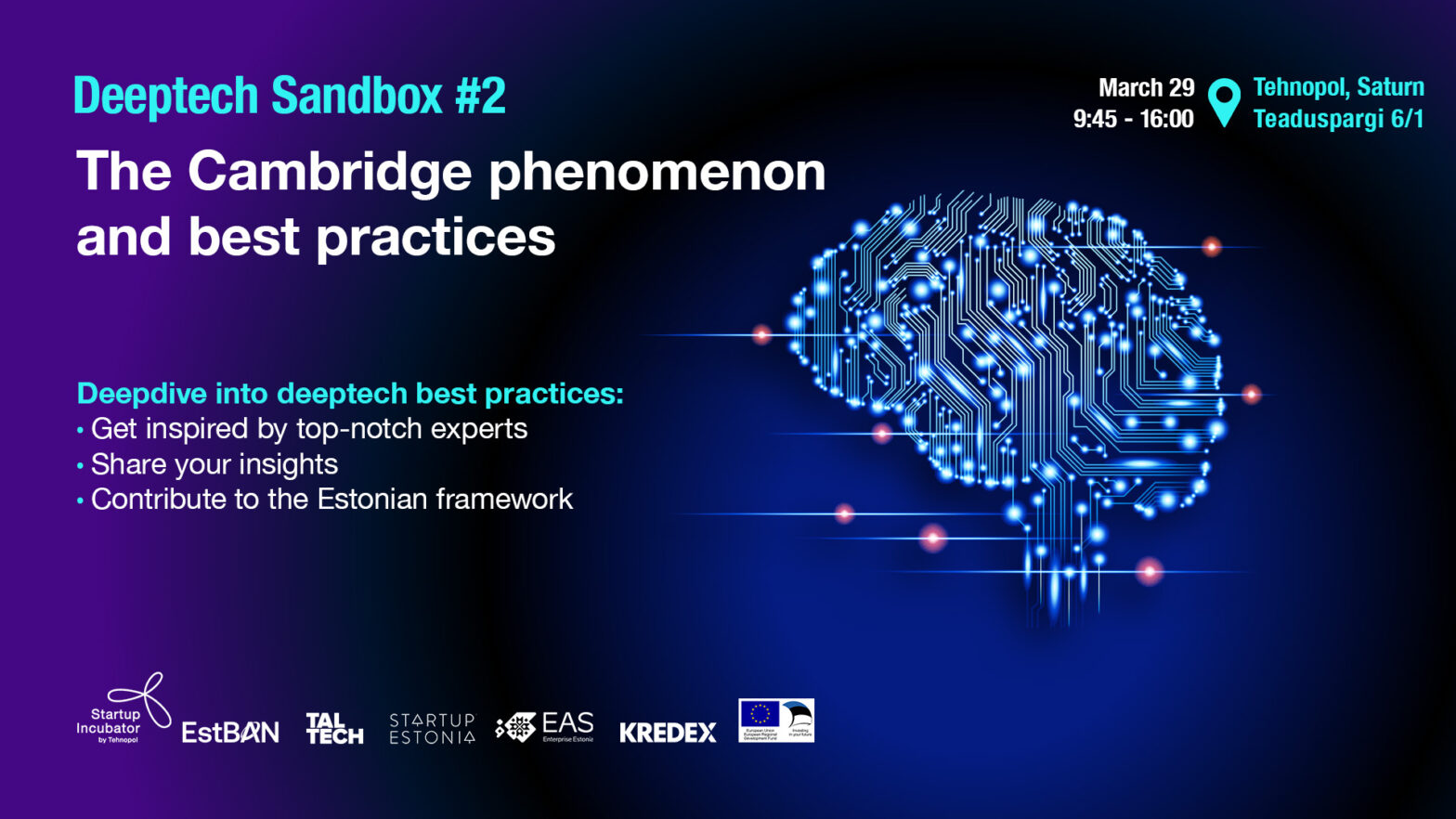
DeepTech Sandbox Summary
In the first half of 2023, the participants of the Estonian deep tech ecosystem had a unique opportunity to learn from the best practices of three leading deep tech ecosystems: the Cambridge region (the UK), the Eindhoven region (the Netherlands), and the ecosystem surrounding the Technical University of Denmark. Despite the differences between the ecosystems, it is possible to draw conclusions about which approaches would help more research teams spin out of the Estonian universities and deep tech startups to be more competitive in the international markets. All three ecosystems are united by a strong and consistent focus on the commercialization of research achievements. This allows the research teams to have a clear business development roadmap and an understanding of what are the university’s possible development grants and conditions for transferring intellectual property rights. Estonian universities are taking steps towards increased transparency of technology and knowledge transfer and clear business development roadmaps but can learn from the lessons of our selected ecosystems.
TOP 10 recommendations from Copenhagen, Cambridge, and Eindhoven regions to develop Estonia’s deep tech ecosystem:
1. Clear roadmap to ensure the commercialization of science in all Estonian universities, together with university grants, and conditions for transferring IP to a private company, outlining the conditions for equity taken by the university or licensing fees and the expected time frame of the process. The Netherlands has also followed this path.
2. Consistent public funding for research teams for the proof-of-concept and transition from science to business phase.
3. Investor involvement in the early phase of the company – initially as mentors, later already as a real investor. If possible, the involvement of international investors to open doors to new markets.
4. A clear decision by the research team members, whether to continue as a researcher at the university with a full-time position and have a small (single digit) share in the company or to head fully into entrepreneurship, developing all the necessary skills to become an entrepreneur. 3
5. The capitalization table of university spin-offs must be kept as simple and clean as possible. For universities this means that taking equity in spin-offs must come with clear internal procedures and the speed of decisionmaking like other investors. A good example of moving in this direction is the creation of UniTartu Ventures by the University of Tartu.
6. A platform for researchers and entrepreneurs to connect and find cofounders, mentors, and other help. In Denmark, an online platform was created for matchmaking between spin-offs and potential new team members. An additional step would be the creation of Entrepreneur in Residence programs in all universities and Venture Studio-type programs in science parks.
7. Demand from the government for universities to commercialize science and an understanding that the whole ecosystem, including the public sector, is responsible for contributing to the growth of new sciencebased companies.
8. A clear division of roles between ecosystem members, especially the universities and science parks. The division of roles must be complemented by close collaboration and the early involvement of investors.
9. Clear roadmap for those entrepreneurs who want to become a university spin-in company from outside the university. An analogy here is the Cambridge spin-in model.
10. Encouraging and facilitating the creation of student teams. Based on Eindhoven’s example, providing strong support for early-stage volunteer-based teams of students (such as student formula teams and the student satellite team) working on innovation projects over the space of several years leads to increased publicity for universities, a noticeable increase in startups and spin-offs created, as well as increased employability of graduates who have gained significant practical knowledge. The necessary momentum for Estonia’s deep tech ecosystem to take the crucial next steps has been created.
Lessons from this project serve as a lighthouse to make some vital improvements in the next few years. The conclusions of this program match and complement the deep tech Action Plan put together by Startup Estonia in the spring of 2023.
Organizers: Science and Business Park Tehnopol, Estonian Business Angels Network (EstBAN), Tallinn University of Technology (TalTech), and Startup Estonia.


Alpine House accelerator program
Beginning in 2018 and running for four years, the Alpine House accelerator program, orchestrated by partners Kalev Kaarna, Veljo Otsason, Rain Rannu, and Marek Kiisa, overcame early challenges and the global pandemic to advance startup growth significantly. This initiative, funded by Smartcap and led by Superangel, assisted 28 out of 33 startups in raising €47 million in collective funding.
Over 4 years, Superangel accelerated 33 companies in the program and invested in 23 of these during the program. 11 startups out of 33 raised more than 1M€, including Montonio Finance, Remato, Fyma, Kingdom, Upsteam, eAgronom, Lightcode Photonics, Vok Bikes, Recruitlab and Eyevi Technologies. In Q2 2023, Superangel also invested in Paul-Tech, a program alumnus, by raising the total to 24 startups.
Adapting its operations to suit the participants’ evolving needs, the program highlighted timely advice’s critical role, hackathons’ utility, and the transformative power of leadership coaching.
Although the program has been concluded, the network of experts and the community it built continue to provide enduring support to the startup ecosystem.
More than 80 researchers attended the webinar, with Milan and Alexander giving exciting talks about academic and investor perspective to the Lean Startup philosophy in context of scientific discovery process. PhD pitch was made by Mladen Popović, research associate at the University of Niš, doctoral student in Linguistics, in the fields of Psycholinguistics and Multimodality. Mladen presented the initiative of the team of PhD students who is working on Eye Tracking Technology and its application in the field of UI/UX design, advertisement and content optimization.
🔎 Check out the recording of the webinar here. Find slides from the webinar here and here.